KARMA
An Article by CHristmas Humphreys
co-founder of the Trust

The following has been adapted from 'Karma and Rebirth' by Christmas Humphreys, first published 1943 (last reprint 1959) by John Murray (publishing house) London. It is now out of print.
"The author claims no authority for views expressed which have been taken from the Ancient Scriptures of the Hindoo and Buddhist teachings and the writings of H.P. Blavatsky.
In one of the oldest known Hindoo scriptures Karma is referred to as 'a mighty secret which only the initiated know'.
Ananda says to the Blessed One: 'How deep is the Causal Law, and how deep it seems. And yet do I regard it as quite plain to understanding.' To which Buddha replied: 'Say not so, Ananda, say not so. Deep indeed is the Causal Law, and deep it appears to be. It is by not knowing, by not understanding, by not penetrating this doctrine that the world of man has become entangled like a ball of twine, unable to pass beyond the world of woe and the ceaseless round of rebirth.' "
The Law of Karma
The word Karma, or in its neuter form, Karman (in Pa1i, Kamma), is a Sanskrit word from the root kri, meaning to do or to make. Karma is therefore 'doing' or 'making', but in the course of time the word has been applied to what Lessing has described as the oldest doctrine in the world. It may be viewed exoterically, from the material point of view, in which case it is merely the law of causation, the balance of cause and effect, the fact known in every science laboratory that action and reaction are equal and opposite. Esoterically, from the spiritual point of view, Karma is the law of moral retribution, whereby not only does every cause have an effect, but he who puts the cause in action suffers the effect.
Professor Radhakrishnan has called it 'the law of the conservation of moral energy. It is magnificently described in the eighth book of the Light of Asia, one stanza of which must here suffice.
That which ye sow ye reap.
See yonder fields!
The sesamum was sesamum, the corn
Was corn. The Silence and the Darkness knew!
So is a man's fate born.
This law of merit and demerit, Karma in the sense of the reign of moral law, is neither particularly Hindu, Buddhist nor Theosophical. It is fundamental in all Oriental philosophy, and was preached by St. Paul. "Brethren, be not deceived. God is not mocked, for whatsoever a man soweth that shall he also reap." For the first few centuries of Christianity it remained a cardinal belief in the West. But at the Council of Constantinople, in A.D. 551, the Christian Fathers, finding the doctrine of Rebirth incompatible with the curious system of thought which they were in the process of creating, decided that belief in Rebirth should be henceforth anathema, and with this doctrine went that which makes it necessary of acceptance, Karma. Now, under the double influence of English translations of the Hindu and Buddhist Scriptures, and the reproclaiming by Mme Blavatsky of the Ancient Wisdom, or Theosophy, of which all religions are part, Karma and Rebirth have returned to the West, and a glance at chapter VII of this book will show to what a wide extent the dual doctrine has proved acceptable.
Either it is true or false. The Universe is either cosmos or chaos, for it cannot be partly ruled by law and partly by a blind, unreasonable chance. Karma is not a law of which it can be said: 'There may be something in it'. Either the Law exists or it does not. If it exists, he is a fool who does not use it, and he alone is wise who studies it, proclaims it far and wide, and applies it to the smallest detail of his daily life. If it be not true it is a strangely venerable error, and seeing that it has been taught as the basis of the world's accumulated wisdom since, it would seem, the search for truth began, it is strange that no other Law has been propounded to explain this life's phenomena. But the Law is only understandable from the spiritual point of view. To regard it as a mechanical law of debit and credit for good and evil actions is to rob the doctrine of its living power. If it is all-embracing, coeval with the Universe, it can only be grasped from a universal, that is to say, a spiritual point of view. Man has many levels of cognition, windows on the spiral staircase of his understanding, and even as the lighthouse-keeper, whose tower is based in the living rock, climbs to the level of the lantern where he tends the light which is not his light, so man's evolving consciousness must climb from plane to plane until he finds, and learns to tend, the Light within, which shines eternally. Beyond the intellect, which is the machinery of thought, is the plane of the intuition, the faculty of an immediate, direct cognition of Reality. In most of us it sleeps, or functions dimly in a low reflection as the ‘instincts’ or on the psychic plane. Yet all may develop it, and none may know the Law who has not to some extent acquired it as an active instrument. At first it serves to illumine the intellect with fitful flashes of understanding; later, the ascending consciousness begins to use it on its own plane, and he who has experienced such dazzling glimpses of 'the heart of things’ will know, and know beyond all doubting, that the Law is true. Meanwhile, on the level of the intellect, where doubts arise and cloud the understanding, the Law can only be viewed as a doctrine of sweet reasonableness which, in the workshops of experience, is tested and found true. Karma is a Law, a Law which dominates all other natural laws, from gravity to the law of averages, but it is not blind Law. It is living and intelligent as all else in the Universe. There is no such thing as either 'dead' or 'blind' matter, as there is no 'blind' or 'unconscious' Law, for “the Universe is worked and guided from within outwards. As above so it is below, as in heaven so on earth; and man, the microcosm and minature copy of the macrocosm, is the living witness to this Universal Law, and to the mode of its action".
The Wisdom Religion
From this it must be obvious that in order to understand Karma it is necessary to have some knowledge of the Wisdom of which it is the basic law. Only then will it be seen as a necessary part of the cosmic Whole, and the place of man, the law-giver who is yet subject to the law, made clear. This Wisdom-Religion, older than any known religion, will be found to be based upon three fundamental Principles. These are necessarily difficult to describe, first because they speak of things which lie beyond the range of our limited intelligence, secondly because any description involves the use of words and names, and both are widely different in the various descriptions of the Principles, and thirdly because any attempt to define and describe such cosmic Laws is like picking up a handful of a rushing stream or attempting to pigeon-hole the tide.
The Ultimate Principle, which all the capital letters in the alphabet can never describe, is the Parabrahman of the Hindus, the Adi Buddha of the Mahayana Buddhists, the Fana-al-Fana of the Sufis, and the Tao, in its highest sense, of the Taoists. It is, in the words of The Secret Doctrine:
"An Omnipresent, Eternal, Boundless and Immutable PRINCIPLE, on which all speculation is impossible, since it transcends the power of human conception and can only be dwarfed by any human expression or similitude. It is beyond the range and reach of thought."
It is, as the writer later says, 'Be-ness' rather than Being, and many prefer to consider it as the ultimate Namelessness. It is important to note further that 'its impersonality is the fundamental conception of the System', and that it is therefore utterly beyond the limited and limiting belief in a personal God. 'It is latent in every atom of the Universe, and is the Universe itself.'
But 'Be-ness', to be recognizable to itself, must manifest, and the manifested Universe is the Field of Becoming whereon the One unrolls into the Many and returns again. This periodic 'rolling and unrolling', as the Buddhist Scriptures call it, occupies immense though not, it is said, incalculable periods of time. It demonstrates 'the universality of that law of periodicity, of flux and re-flux, ebb and flow, which physical science has observed and recorded in all departments of nature' and which is contained in the Buddhist doctrine of anicca; ceaseless change. The Universe when manifest is but of relative Reality, or Maya, yet deep in the heart of each of the Many is a fragment or ray of the One, and each human mind is an aspect or ray of the Universa1 Mind - the 'Essence of Mind' of the Sutra of Wei Lang - which is the 'appearance' of the Namelessness. Within this Field of Becoming the One has become Two. But no two things are cognizable without relationship, and with this relationship the Two become Three.
From Three in turn comes Seven, and from the Seven come what the Chinese call the Ten Thousand Things, the manifested Universe in its infinite diversity. The fundamental 'Pair of Opposites' is Spirit and Matter, Subject and Object, the Purusha and Prakriti of Indian philosophy, and from the interplay of this original duality is spun on the warp of motive and the woof of acts, the Karma which we create and suffer, create and suffer as the Wheel of Becoming turns unceasingly.
The third Fundamental Principle is sometimes called the Cycle of Necessity, the necessary pilgrimage of every 'soul' (using that term as the ray of the Flame in every man), from purest 'Spirit' into darkest 'Matter' and then, on the return journey, 'home' . Within this mighty cycle of one complete unrolling and re-rolling of the Universe there are, of course, an infinity of lesser cycles. Even on this earth itself, subject to cosmic cycles of birth and death, there are tremendous cycles, from those which belong to the field of geology to those which affect the mass migration and the racial cycles of men. Ever the cycle runs - 'Coming to be, coming to be; ceasing to be, ceasing to be' - or, in greater detail, birth, growth, decay and death; birth, growth, decay and death.
What, then, is the place of man in this mighty scheme of things?
Man is a complex entity, and whether he be regarded as the 'spirit, soul and body' of St. Paul, or as the more complex analysis of Indian philosophy, which ignores both the physical body and the spirit and yet leaves five other planes of consciousness, or whether the number be carried to seven, as set out in the Ancient Wisdom itself, is a matter of terminology and choice. For the purpose of this account of Karma and Rebirth the Pauline analysis will suffice. Man is spirit, that is to say, he is of the very essence of that 'Be-ness' which is 'beyond the range and reach of thought' , and the various 'garments' which he wears are the vehicles or instruments through which he contacts the descending planes of consciousness. These bodies or instruments are all made of 'matter', but of matter which at the highest is so fine as to be all but non-existent, and at the lowest is of our 'common clay'. All alike are anatta, that is to say, lacking a permanent life as such, and all are anicca; subject to change. They change with every act at any level of consciousness, for every new cause must modify to some extent the sum total of effects which is that vehicle. It follows that the ultimate heresy, the profoundest error in all human belief, is Attavada, the belief in the essential separateness of any of these vehicles, be it mind or soul or spirit itself, from the Namelessness or infinite SELF of which all manifestation is part. This fundamental principle, the very basis for the solidarity and hence the 'brotherhood' of man, must be thoroughly grasped and assimilated before the law of Karma can be in any way understood.
"We must not lose sight of the fact that every atom is subject to the general law governing the whole body to which it belongs ... The aggregate of individual Karma becomes that of the nation to which those individuals belong, and the sum total of National Karma is that of the world. The evils that a man suffers are not peculiar to the individual or even to the nation, they are more or less universal; and it is upon this broad line of human interdependence that the law of karma finds its legitimate and equable issue." [H.P. Blavatsky]
From this the writer proceeds to one of the finest passages in all her writings.
"It is an occult law, moreover, that no man can rise superior to his individual failings without lifting, be it ever so little, the whole body of which he is an integral part. In the same way no one can sin, nor suffer the effects of sin, alone. In reality, there is no such thing as 'Separateness'; and the nearest approach to that selfish state which the laws of life permit is in the intent or motive."
But if no man's spirit is separate, in that being one with the Namelessness it is not even his, the soul is even less immortal, for it is changing every moment of the day. It is, as will be explained later, equivalent to character, the collection of attributes, good and bad, which make up the man. Still more impermanent is the 'body!, using the word in the sense of the mask or personality through which the soul, and through the soul the spirit, is made manifest. This outward and visible aspect of the man is the densest of his vehicles, being that through which he contacts the lowest planes of matter, yet, said the Buddha, 'In this very body, six feet in length, with its sense-impressions and its thoughts and ideas, I declare to you are the world, the origin of the world and the ceasing of the world, and likewise the Way that leads to the ceasing thereof'. It follows that he who waits for a heaven-world in which to begin his inner development will wait in vain. At page 122 of Dr. Jacobi's Psychology of C. G. Jung, there is a diagram of what that famous psychologist, as a result of a life's work, believes to be the content of the invisible side of Man. 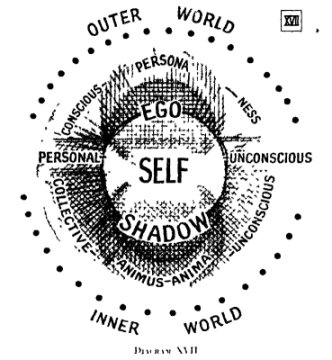 To equate the analysed aspects of man as taught by Eastern philosophy with the empirically discovered equivalents in Western psychology is a task which probably only a Dr. Jung could at the moment undertake, but those who meditate upon the respective analyses will learn a vast amount from the comparison. In either case the teaching is insistent on the indivisible wholeness of the thing we know as man. Whether his 'skins' be compared to those of an onion, which may be successively removed, or his consciousness be compared to that of a lighthouse-keeper, as in the analogy used above, or the various aspects be built into a glyph or diagram, ever the SELF and all its vehicles is One, even as Karma is One, for both are subject to and aspects of the 'Be-ness' without name.
For the study of Karma it is best to consider the man at the level of his individuality or 'soul'. Here the Self creates, uses, suffers and in a very real sense is its Karma, and those who study Jung's diagram will note with interest that this Self unites the most outward and most inward, most material and most spiritual parts of the whole. For the keynote of the law of Karma is equilibrium, and nature is always working to restore that equilibrium whenever through man's acts it is disturbed. As Emerson wrote:
"If you love and serve men, you cannot by any hiding or stratagem escape the remuneration. Secret retributions are always restoring the level, when disturbed, of the divine justice. It is impossib1e to tilt the beam. All the tyrants and proprietors and monopolists of the world in vain set their shoulder to heave the bar. Settles for evermore the ponderous equator to its line, and man and mote, and star and sun must range to it, or be pulverized by the recoil."
To the same effect wrote H.P. Blavatsky:
"The only decree of Karma, an eternal and immutable decree, is absolute Harmony in the world of Matter as in the world of Spirit. It is not, therefore, Karma that rewards or punishes, but it is we who reward and punish ourselves, according as we work with and through Nature, abiding by the laws on which that harmony depends, or breaking them."
And this in turn was echoed by W.Q. Judge, her pupil, when he wrote, in his famous Karmic Aphorisms, 'Karma is an undeviating and unerring tendency in the Universe to restore equilibrium, and it operates incessantly.' Because this ceaseless effort to adjust a troubled harmony takes time, the doctrine of Rebirth is a necessary corollary of Karma, for the longest life on earth will not suffice to restore the harmony disturbed by a daily round of self-regarding actions; life after life must pass before the ultimate lesson is learned, and the 'triple fires' of hatred, lust and illusion die for want of fuelling.
Karma is the master Law of the Universe, but there is no Lawgiver. Its Ultimate Cause, as the ultimate cause of anything, is of course unknown and to our intelligence unknowable, but it is certainly not 'God', as the Church which claims the name of Christianity conceives that term. Absolute Consciousness, or 'Adi-Buddha', however one may name the Namelessness, is as beyond the conception of a personal God as the sea is greater than a stream. The anthropomorphic God is only, as Colonel Olcott wrote, 'a gigantic shadow thrown upon the void of space by the imagination of ignorant men', even as 'the Tao that can be talked about is not the eternal Tao, so 'a man can have no God that is not bounded by his own human conceptions. The wider the sweep of his spiritual vision, the mightier will be his deity. But where can we find a better demonstration of Him than in man himself - in the spiritual and divine powers lying dormant in every human being?'
The Law is all-embracing. As is said in one of the most famous passages in the Dhammapada, 'Not in the sky, not in the midst of the sea, not if we enter into the clefts of the mountains, is there known a spot in the whole world where a man may be freed from an evil deed.' None is above the Law save he who has attained, by his use of the Law, supreme enlightenment, and then only because with the dissolution of the Self which caused the Law to be set in motion, there is no longer an object on which the Law can operate.
The Law is timeless, therefore, in that it will last for as long as there remains a single being in whom it can and must inhere. Its patience is inexhaustible -
"Times are as nought, tomorrow it will judge, Or after many days."
Such is the Law, and it is the basis of all truth. As Paracelsus wrote; 'Philosophy is only the true perception and understanding of Cause and Effect'.
Karma - Action
Karma creates nothing
"Karma creates nothing, nor does it design. It is man who plans and creates Causes, and Karmic Law adjusts the effects, which adjustment is not an act, but universal harmony, tending ever to resume its original position, like a bough which, bent down too forcibly, rebounds with corresponding vigour".
It is man who creates his Karma, for it is the product of his thought. As is written in the most famous verse in the Dhammapada; 'All that we are is the result of what we have thought; it is founded on our thoughts, it is made up of our thoughts'. Note the corollary which follows, when harmony demands the corresponding effect:
'If a man speaks or acts with an evil thought, pain follows him, as the wheel follows the foot of him who draws the carriage. But if a man speaks or acts with a pure thought, happiness follows him, like a shadow that never leaves him'.
It is of great importance to grasp the fundamental fact, as expressed by W.Q. Judge in The Ocean of Theosophy, that 'No act is performed without a thought at its root, either at the time of performance, or as leading to it'. According to Indian philosophy, the sequence is ignorance, desire, will, thought and act. First comes, Avidya, Ignorance, because all manifestation, and all that proceeds within it, is unenlightened. In his ignorance man desires things for himself, believing that he has a 'self' which has interests of its own. 'Man is altogether formed of desire; according as his desire is, so is his will; according as his will is, so are his deeds; according as are his deeds, so does it befall him.' But between the will to act and the act is thought, the conception within the mind of which the act is the visible expression. It follows that control of thought, with which is included emotion, is a necessary prelude to control of action, for, as a man thinks, so he becomes.
Thus man, as spirit, as the highest self-conscious aspect of the One Life, rules the Universe with the aid of Karma. But once he has created Karma, as he does with every act, he must necessarily bow the knee to the Nemesis of his creation, and it is not for him to complain that Fate, against his will, has bound his actions or decreed an unjust doom. 'Karma-Nemesis is no more than the spiritual dynamical effect of causes produced and forces awakened into activity by our own actions.' The higher the plane from which the harmony of nature is disturbed, the more powerful the reaction to the act.
'It is a law of Occult dynamics that a given amount of energy expended on the spiritual or astral planes is productive of far greater results than the same amount expended on the physical, objective plane of existence.'
The Law of Karma, therefore, is utterly impersonal, being the servant of its creator, man, and not the whim of a benevolent or avenging God. It follows that it is useless to attempt to placate it, pray to it, argue with it or defy it; for 'as a man thinks, so he becomes'.
Yet it is, be it emphasized, supremely intelligent, and it therefore works through intélligent agents . These agents are manifold in kind.
Agents of Karma
'The whole Cosmos is guided, controlled and animated by an almost endless series of Hierarchies or sentient Beings, each having a mission to perform, and who - whether we call them Dhyan Chohans or Angels - are 'Messengers' in the sense only that they are the agents of Cosmic or Karmic Laws. They vary infinitely in their respective degrees of consciousness and intelligence ... Each of these Beings was, or prepares to become, a man.' [H.P. Blavatsky]
Such are the Buddhist Avalokiteshvyara and Amitabha, and the four 'Regents of the Earth' who appear in many mythologies, and the 'Thrones, Dominions and Powers' of Christianity. But there is an ancient tradition that by reason of their own past karma certain human beings act in a given life as focal points for mighty happenings, lightning conductors, as it were, through whom the Karmic force is 'earthed'. These are men to whom and about whom things of wide importance are always happening, whether they be at the head of a nation or a factory, but they are quite unconscious of their special, self-attracted function. Only a genuine Adept, one who has attained Enlightenment, can consciously control the forces of mass Karma, and so be a conscious agent of the Law. [Editors note: At this point the following sentence is marked for possible deletion by the writer: Incidentally, somewhere in this esoteric aspect of Karma must be incorporated the 'archetypal images' of Jung's discovery, but this, although a fruitful field for later research and consideration, is beyond the scope of the present volume.]
It would seem that man is responsible only for such acts as are generated in the mind. He is not, in other words responsible for actions where the thought or intent did not run with the deed. If, for example, in turning quickly on a station platform someone bumps into a person standing close behind him, and so tips him on to the line in front of a train, he would not be responsible for a death which he never intended. Here the Law would seem to be the 'above' of which our English law is the reflected, though unconsciously reflected 'below'. For in English law there must, to constitute responsibility, not only be an actus reus, the wrongful deed, but also a mens rea, the wicked [guilty] mind. A man is not responsible for a pure accident unless it was caused by such gross negligence that he must be held to have intended the 'natural and probably consequences' of his act. In the same way lunatics, children and persons completely drunk may be incapable of the mens rea which is a necessary ingredient of their responsibility.
This, however, is an over-simplification of an intensely difficult subject, for the latest discoveries in psychology enormously widen the range of the word 'intend'. One may, for example , 'intend' those acts which seern the very reverse of those apparently intended, and the most fantastic 'accident' may be a deliberate act by the unconscious, though fiercely repudiated by the conscious mind. Many an apparently accidental death, for example, is unconscious suicide, and many an injury caused to another may be deliberate at unconscious levels though unintended by the normal consciousness. The mind of man is a realm of which but a tithe is yet explored, and that bit superficially, and the oft-repeated cry from the dock, "I don't know what came over me". displays, to the trained psychologist, a hidden motive which the victim of his own unconscious genuinely denies.
One clue to the mystery may lie in the fact that an act has separate and often different effects on the various planes of consciousness. A millionaire, for example, may build a local hospital at vast expense and offer it to the town. The effect of his generosity will appear on different levels of his being. The outward deed was good, and will produce 'good' Karma, whatever the motive, but the mental effect will vary with the motive. If the reason of the gift was a genuine desire to use his worldly means for the benefit of his fellow men, his mind will be ennobled with the deed. If, on the other hand, his secret motive was the love of applause or, worse, a desire to curry local favour before standing as the town's representative in Parliament, then the effect on his mind will be that of the misuse of a power for selfish ends.
Further light on our responsibility for 'accidents' is furnished by returning once again to the basic principles on which the Universe is built. Life is One, and all its forms are interrelated in a vastly complicated but inseverable whole. It follows that every act by any form of life, from the highest to the lowest, must react on every other form. The power of thought is terrifying, for thoughts are truly things, and once created have an independent existence of their own. The length and strength of this life depends on the intensity and clarity of the thinker's mind, but good or bad, each thought is a power, a living power for good or evil respectively. As such it affects not only the thinker, ennobling or debasing his mind for future thinking, but it affects all other life in the Universe. As A.P. Sinnet wrote in The Occult World:
'Man is continually peopling his current in space with a world of his own, Crowded with the offspring of his fancies, desires, impulses and passions; a current which reacts on any sensitive or nervous organization which comes in contact with it, in proportion to its dynamic intensity.'
As the average mind is too undeveloped to confine the springs of action to its own thought alone, most men are at the mercy of the myriad thoughts which press upon the brain as bodies press one's body in a swaying crowd, and each man's actions are to that extent the effect not merely of his own volition but of the mass volition of the crowd. Hence the well-known phenomena of 'mob psychology', the power of slogans, the whims of fashion, the speed of rumour and, generally, the suggestibility of the weaker by the stronger mind.
Motive, therefore, is the dominating factor in every act, for the act that springs from 'accident' if such there be, will at any rate have less effect than the carefully intended act. Acting from the highest levels in his being, man is the creative and controlling force in the Universe; acting from the lowest he is the worst enemy both of himself and the One Life. He can, if he did but know it, control the forces of nature consciously as he at present uses them unconsciously to produce their inevitable effect. Whether the use of these forces is 'white magic' or 'black magic' depends on the motive alone. Every act is in accordance with or against the stream of progress. He who swims with the current will the sooner reach the sea; he who swims against it will sooner or later suffer for his determined folly and in the end, broken and exhausted, move unwillingly down to the self-same sea.
Hour by hour we are choosing our direction, and the Law with utter justice acts accordingly. The choice between right and wrong is difficult enough to make at times, but the choice is harder still when it lies between right and right. Each man has many duties and many loyalties, and when they conflict it is hard to decide which is the more 'right' of the two. Yet the choice must be made, on principle and, if the heart be stout enough, 'in the scorn of consequence'. Thereafter the effect on various planes will mirror the wisdom and the selflessness of the decision made. Better, the Wisdom seems to say, a firm decision which, when found to be wrong, is as firmly changed and the punishment of error cheerfully borne than a vacillation which, if it breeds not error, breeds no right, and carries the weakling mind no further on the road to self-enlightenment.
'Life becomes what it does.' There, in five words, is the essence of the Law. It follows that 'human history, from one point of view is nothing but a record of the Karma of Humanity, working itself out according to the good or evil of our racial, national and personal deeds'.
Man is his Karma, and his deeds are part of him. Hence Maurice Maeterlinck's famous saying, 'let us always remember that nothing befalls us that is not of the nature of ourselves'. Or, to quote from Edwin Arnold's Light of Asia:
Karma - all that total of a soul
Which is the things it did, the thoughts it had,
The 'Self' it wove - with woof of viewless time
Crossed on the warp invisible of acts - ...
Compounded of good and evil, man as we know him is good in proportion as he has found the Light within, and learnt to 'let the Light shine'; and he is bad to the extent that he is still under the dominance of Maya, illusion, and lets himself be led by the lower, personal desire.
Man is punished by his sins, not for them. Karma neither rewards nor punishes; it only restores lost harmony. He who suffers deserves his suffering, and he who has reason to rejoice is reaping where he has sown. But even if all deserve their suffering, in that they have caused it, there is no excuse for callous indifference to their suffering by those more 'fortunate'. In the long run there is no such thing as personal Karma, for the acts of one are the acts of the whole, and the acts of the whole react on its littlest part. This vast and comprehensive blending of innumerable Karmas is the basis and the bedrock of the cosmic truth of Brotherhood. All things are in their essence good, and suffering is the servant of this Good. By that we learn, and in our common suffering move, by infinitely slow degrees, to that 'far off divine event to which the whole creation moves'.
Nevertheless, though men are in essence One they are, at their present distance from enlightenment, separate entities, and though Karma reflects in all the acts of each, yet the average man is a Karmic unit, as it were, who suffers the good and evil results of his actions. This fact is the basis of the doctrine of merit, of which so much appears in Buddhist literature. All good acts acquire merit for the actor in that at some future date, in this life or a later one, the cause will bear its due effect. This is a fact, but it is a low, unworthy motive for the doing of good deeds.
Rewards for Merit
As the Chinese Taoist, Chuang-Tzu, proclaimed, 'Rewards and punishments are the lowest form of education'. The reason is that behind such motive is the spur either of fear or else of low desire for the pleasure which the noble deed is believed to bring. This limitation of thought may serve, like blinkers, to keep the thinker to a simple ethical code, but will not produce enlightenment. In a talk to an American audience Krishnamurti said that such 'thought cannot escape from its limited action and reaction until it understands deeply and fully the cause and process of its own bondage' . When such limited thought expresses itself in action, he goes on, that action creates further limitation of thought.
Into this simple reality, reward and punishment have been introduced to deter so-called wrong action. If one is good - the good depending on limitation of thought, not upon understanding - then in the future or in the next life one will be suitably rewarded, and if one is not, one will be suitably punished. This element of fear, as reward and punishment, destroys understanding and love. If thought is influenced by reward and punishment, gain and loss, it cannot understand the craving that seeks reward and avoids punishment. Thought can only understand its own process if it does not identify itself with and cling to any of its own creations, any of its outgoing desires.
None the less, the doctrine of merit is a useful application of the Law of Karma to the daily round, for whatever the motive the habit of good deeds will purify the mind, and prepare it for greater widening of its scope. A better motive for right living is a wider appreciation of the Law and its relation to the Universe as a whole. With an understanding, however dim, of the basic unity of life and the interrelation of all its members comes the desire to assist all life towards enlightenment. This refined still further, awakens finally the highest springs of action, 'to live by Law, acting the Law we live by without fear'; so to have found and known the Essence of Mind that nought is felt to be right save that which serves it utterly. So long as merit and demerit is the motive-power of action there is the danger of that heartless snobbery of thought which, seeing suffering, remarks that it must be the sufferer's Karma to suffer, and anyhow, what is it to do with me? Such thought will bear its own result, a further hardening of the heart which, blinded with its dear delusion, continues to feel separate from its fellow men and, like the Levite, passes by on the other side. Only the light of compassion, an understanding love for all that lives, can see that Karma as Law is a loving Law; that if it is just it is also utterly merciful. We who on earth make laws with which to judge our fellow men know that our justice is fallible, and therefore add to the cold machinery of justice the warmer quality of mercy which, so far from dropping like a gentle dew from heaven, is a virtue latent in the human heart. For 'Compassion is no attribute. It is the Law of Laws, - eternal Harmony, Alaya's SELF; a shoreless universal essence, the light of everlasting right, and fitness of all things, the law of Love eternal'. Only he who sees that law and justice and mercy and love are so many aspects of the Law of Harmony will understand that Karma is only a name we give that Law.
The Planes of Karma
Karma reacts on all three planes, the mental, whence it originally sprang, the psychic and the physical, and the makeup of a man in any life will accord with the differing Karma that he has produced on the several planes of consciousness. A great mind may abuse its body and be reborn with a poorer one; a glorious body, exquisitely cared for, may harbour a poorly developed or even vicious mind. Yet the interaction is close. 'As we think, so we are', and evil thought will mar the body even as it shows in the face. Again, the evil in the mind may be rectified by a greater understanding long before the effect, say, of cruelty practised by the body has worked itself out on the physical plane. Hence the hunch-back with a lovely mind.
In the well-known chapter on Karma in her Buddhism, its Doctrines and Methods, Madame David-Neel describes the Tibetan classification. General Karma perpetuates the round of existence as set out in the twelve Nidanas, which may be applied to all manifestation. Then comes Inanimate and Animate Karma. The Karma of 'inanimate' objects proceeds on the cyclic law of birth, growth, decay and death. Animate beings are subject in addition to moral Karma, that is, Karma that originates in the mind and for which the 'individual' is responsible. Finally, with man there is the still more particular Karma wherein he is his Karma, and as such and only as such moves from birth to birth towards enlightenment.
Finally, for the present purposes, Karma may be classified in terns of the size of the unit involved. A group or club or society may have its collective Karma as much as that smaller 'group of qualities' we call a man. In the same way a nation will not only reap the benefits and evil of its collective acts, but re-incarnate in the larger cycle of its destiny. Rome and Greece were units of rebirth, and the Punic wars are with us again today. Red Indians will appear in the race that slew them in such quantity, and many a minority movement in a country represents some olden enemy returned, this time, within the gates to continue an age-long war. He who would understand the pattern of history cannot ignore the doctrine of Karma; still less can he ignore Rebirth.
Karma, then, is the fundamental Law that rules all manifested things, and man, the conscious user of it, is but another aspect of the Namelessness. The Law was born when man was born, and will die 'when every blade of grass has entered into enlightenment'. It is utterly impersonal and absolutely just. It strives for harmony, and he who disturbs the harmony must suffer the adjustment. The Law has agents, human and 'divine', yet these, the demi-gods, are likewise subject to its sway. Man is punished by his sins, not for them; it follows that there is no such thing as forgiveness and therefore none who can forgive. Yet the Law is merciful, for the Law is Love.
 Christmas Humphreys was born in London in 1901, and originally trained as a lawyer. Justice Christmas Humphreys made quite a career for himself, serving as Senior Prosecuting Counsel at the Old Bailey, the London criminal courts, and eventually sitting as a Circuit Judge from 1968 until his retirement in 1976. Parallel with this career he cultivated his interest in Theosophy & Buddhism, and in 1924 co-founded the Buddhist Society, London, now one of the largest and oldest Buddhist organisations outside of Asia. As a publisher to the Buddhist Society, he was responsible for its wide range of publications, including six of his own. He supported Geoffrey Farthing in the establishment of The Blavatsky Trust and served as a founding Trustee from 1974